Connect an analog joystick to an Arduino. Read two analog values (x- and y-position) and a switch using a method witch does not hog the processor during the whole ADConversion.
The capacitor reduces digital noise on the analog readings.
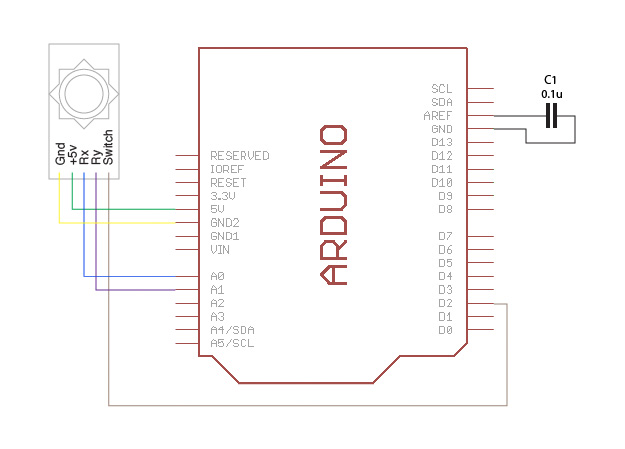
Code
static const byte ADC_CHANNEL_JOYSTICK_X = 0;
static const byte ADC_CHANNEL_JOYSTICK_Y = 1;

static const byte ADC_CHANNEL_MAX = 2;

byte adc_channel = 0;
bool joystick_button = 0; // 1 or 0
uint16_t joystick_x = 0; // 0~1023
uint16_t joystick_y = 0; // 0~1023


void setup() {
 Serial.begin(115200); // Remove

 pinMode(A0, INPUT); // Analog pin A0
 pinMode(A1, INPUT); // Analog pin A1
 pinMode(2, INPUT_PULLUP); // Digital pin 2

 // Setup adc
 ADCSRA |= 1 << ADEN; // Enable ADC, with no interrupt!
 ADCSRA |= ((1 << ADPS2) | (1 << ADPS1) | (1 << ADPS0)); // Main clock / 128
 ADMUX = adc_channel; // Channel
 ADMUX |= 1 << REFS0; // Aref pin -> 100nF -> gnd
 ADCSRA |= 1 << ADSC; // Start first conversion
}


void loop() {
 byte changed = 0;

 // Analog
 if ((ADCSRA & (1 << ADSC)) == 0) { // ADC done
 changed += read_analog();
 }

 // Digital
 changed += read_digital();

 // Tmp
 if(changed > 0) {
 Serial.print("x: ");
 Serial.println(joystick_x);
 Serial.print("y: ");
 Serial.println(joystick_y);
 Serial.print("button: ");
 Serial.println(joystick_button);
 Serial.println();
 }
 delay(100); // Remove
}


byte read_digital() {
 byte state = 0;
 byte val = !(bool)(PIND & 0b00000100); // PORT IN D, pin nr 2
 if(val != joystick_button) {
 state = 1;
 joystick_button = val;
 }
 return state;
}


byte read_analog()
{
 byte state = 0;
 uint16_t val = ADC; // ADC is the full 10-bit, two-register, value from the last ADConversion

 switch(adc_channel) {
 case ADC_CHANNEL_JOYSTICK_X:
 if(joystick_x != val) {
 state = 1;
 joystick_x = val;
 }
 break;
 case ADC_CHANNEL_JOYSTICK_Y:
 if(joystick_y != val) {
 state = 1;
 joystick_y = val;
 }
 break;
 }

 adc_channel++;
 if(adc_channel >= ADC_CHANNEL_MAX) adc_channel = 0;
 ADMUX = adc_channel; // Channel
 ADMUX |= 1 << REFS0; // Aref pin -> 100nF -> gnd
 ADCSRA |= 1 << ADSC; // Start next conversion

 return state;
}