Synth Repair

Ursa Major Space Station SST-282, 82S123 replacement

How to make a replacement for the 82S123 ROM chip (ADS-1 board – U19) in Ursa Major Space Station SST-282, using an 22v10 Programmable Logic chip and a cheap EPROM programmer. I used Atmel ATF22v10CQZ-20PU and the common TL866iiPlus. This is not a step-by-step guide, you are expected to know how to use an EPROM […]

Read More
Synth Repair

The differences between Roland Juno-106 and MKS-7

This page compares the Roland MKS-7 to the Roland Juno-106. To understand it, you need to know the Juno-106. Some people say the MKS-7 is the rack version of Juno-106. But it’s more… and less. The Roland MKS-7 was allegedly intended for MIDI-file playback and karaoke, thus being a consumer market product. The voicing hardware […]

Read More
Synth Repair

Arp Sequencer 1621 / 1601 Button Debounce

While servicing an Arp Sequencer 1621, I noticed that the three button switches were in a bad shape. One button press would produce anything from one to six signal changes. These switches can’t be sourced nowadays. The switches are glued together from factory so they can’t be opened. One possible fix would be to fit […]

Read More
Synth Tuning

Korg Lambda ES-50 Tuning Instructions

Disclaimer: There may be a better way to tune the Korg Lambda. My method is a bit “hit and miss”. Still it took less than five minutes to accomplish. Background The Lambda is not a VCO->Filter->VCA synthesizer, it’s constructed lika an organ / string machine. The tuning procedure is different and often simpler on an […]

Read More
Synth Repair

Korg Poly-61 – Changing the NiCd to a Litium Battery

It was pointed out to me that there is already a modification devised by Korg for this purpose. While my modification works, you should probably stick to Korg’s original Engineering Change Note, even though it’s a bit more complex. The Korg Poly-61 has the same type of battery as the Korg Polysix, the type that […]

Read More
Synth Tuning

PPG 1020 Tuning Instructions

Disclaimer: I have no idea. Maybe this can be done better. But here’s my best shot. Background There is not much technical information around about this very rare synth. In order to figure out how to tune it, I had to remove the front plate which is a lot of work. This article is an […]

Read More
Synth Repair

Roland TR-505 – A Better Mod for Individual Outputs

Descriptions of Individual Audio Outputs modifications for the Roland TR-505 have been around for a while. I searched the web for sources that describe how to do the mod: https://www.circuitbenders.co.uk/drummachine/TR505.html https://masutopedals.wordpress.com/2017/04/20/roland-tr-505-stuff/ There are many sources talking about having it done, without explaining how: http://www.burnkit2600.com/tr-505/#outputs http://gumielectronic.net/tr505.html The problem However, the modifications that are described share one […]

Read More
Synth Repair

Roland CR-8000 BD / SD Mod

This drum machine from 1981 is a close relative of Roland CR-78 and TR-808. It has a couple shortcomings, such as no user editable sounds, a Snare Drum with a lot of tone (what is called “Snappy” on 808) but a lack of noise / high frequency content. It sounds more like a tom. Also […]

Read More
Projects

Toaster with web server

Arduino files download: Sonoff_toaster_timer First install ESP8266 support for Arduino IDE. Follow these instructions: https://github.com/esp8266/Arduino Reprogram Sonoff Smart Switch with Web Server. I didn’t use this in the end, but learned the basics: https://randomnerdtutorials.com/reprogram-sonoff-smart-switch-with-web-server/ ESP8266 ajax – update part of web page without refreshing. The main source for my toaster’s html page: https://circuits4you.com/2018/02/04/esp8266-ajax-update-part-of-web-page-without-refreshing/ ESP8266 Timer […]

Read More
Synth Repair

Doepfer MCV4 Mod for Roland SH5

It seems Doepfer cut some corners when designing the MCV4 MIDI to CV interface. Firstly the MCV4’s gate voltage is to low to drive the Roland SH5 gate input. This can be remedied by opening up the interface to move a jumper, and then replacing the 9v power supply with a 12 volt one. After that the […]

Read More
Synth Repair

Kawai R-100 MIDI-Controlled Pitch and Circuit Bend Mod

A mid-80’s drum machine, modified for MIDI-controlled sound chip selection, circuit bending and pitch. Any MIDI sequencer or keyboard can be used. No changes are made to the exterior of the machine. The Kawai R-100 drum machine classic was modified using an Arduino Nano, the circuitbenders.co.uk “R-ROM Switcher” and a HC-SR08 board. The Nano reads incoming note […]

Read More
Projects

Instruments for exhibition – Control Surface

Two unusual electronic instruments that were part of a greater ensemble, built for an exhibition in China. Idea and hardware by Daniel Araya. Programming and I/O-electronics by 9bit. The MIDI Control Surface The Control Surface is a Standard MIDI Interface compliant unit, built to interface with a MAX MSP patch on a host computer. The […]

Read More
Projects

Instruments for exhibition – Metronomes

Two unusual electronic instruments that were part of a greater ensemble, built for an exhibition in China. Idea and hardware by Daniel Araya. Programming and I/O-electronics by 9bit. The Metronomes Three metronomes were built, one master and two slaves. The tempos of the slave units are synced to the master but the beat patterns that they […]

Read More
Snippets

Avrdude – Burn fuses (16 MHz clock out on CLK0 / B0)

Reason Fuses. There are a couple of user selectable operation modes of the AVR microcontrollers. The fuses can’t be edited in the same way you normally program you Arduino. You will need a hardware AVR programmer, ie the one described here: Arduino as ISP. There are a few GUI softwares that are supposed to do this, but I couldn’t get any of […]

Read More
Snippets

Avrdude – Upload hex file to Arduino using ISP / ICSP

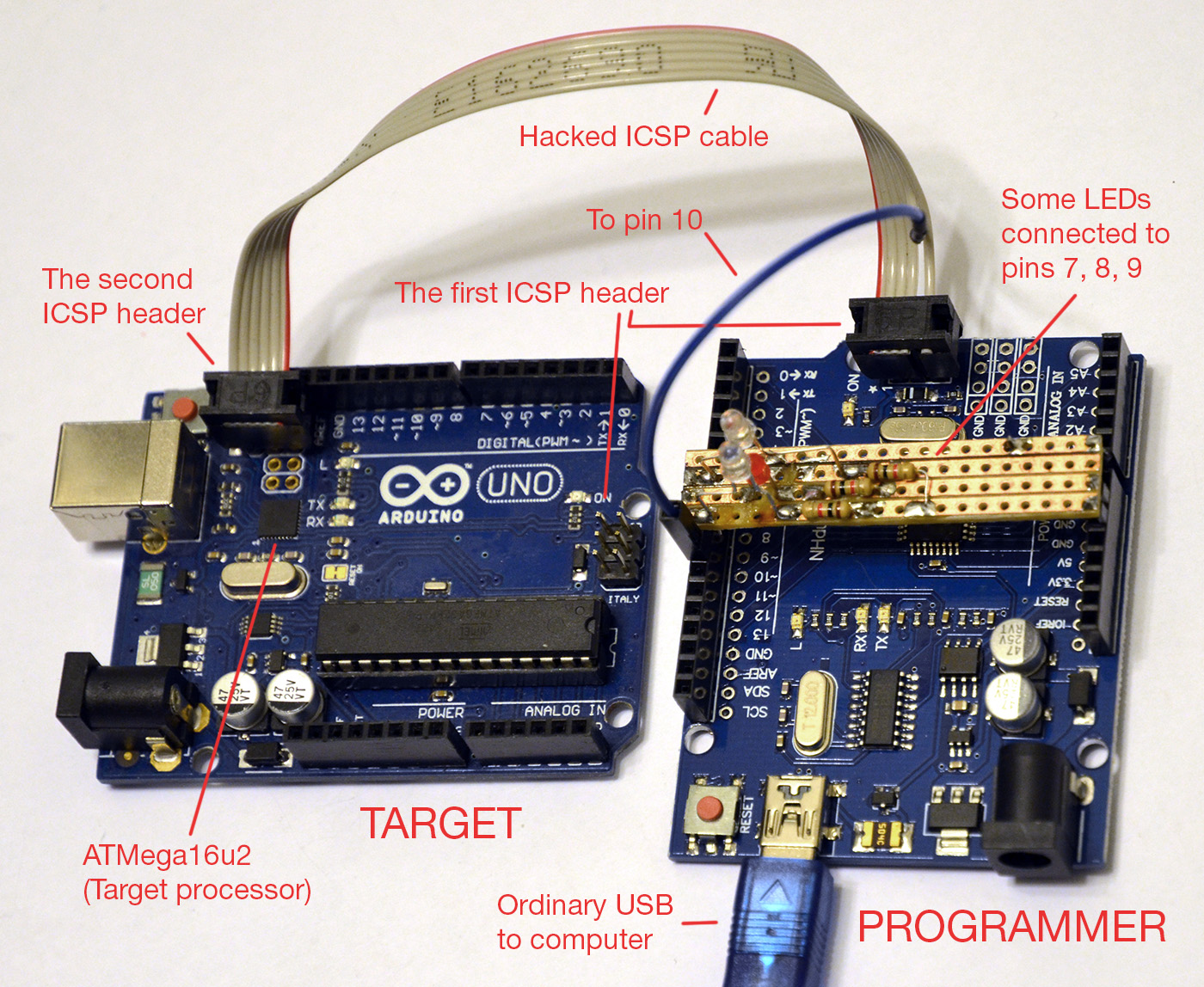
Reason In some cases USB cannot be used to program (upload hex file to) a processor on an Arduino board. One such case is when you are targeting the second processor on an Arduino Uno, the ATMega16u2 whose sole purpose is to cater for USB communication. Please note: Only the original style Arduino Uno R3 boards […]

Read More
Arduino tutorials

Analog Joystick

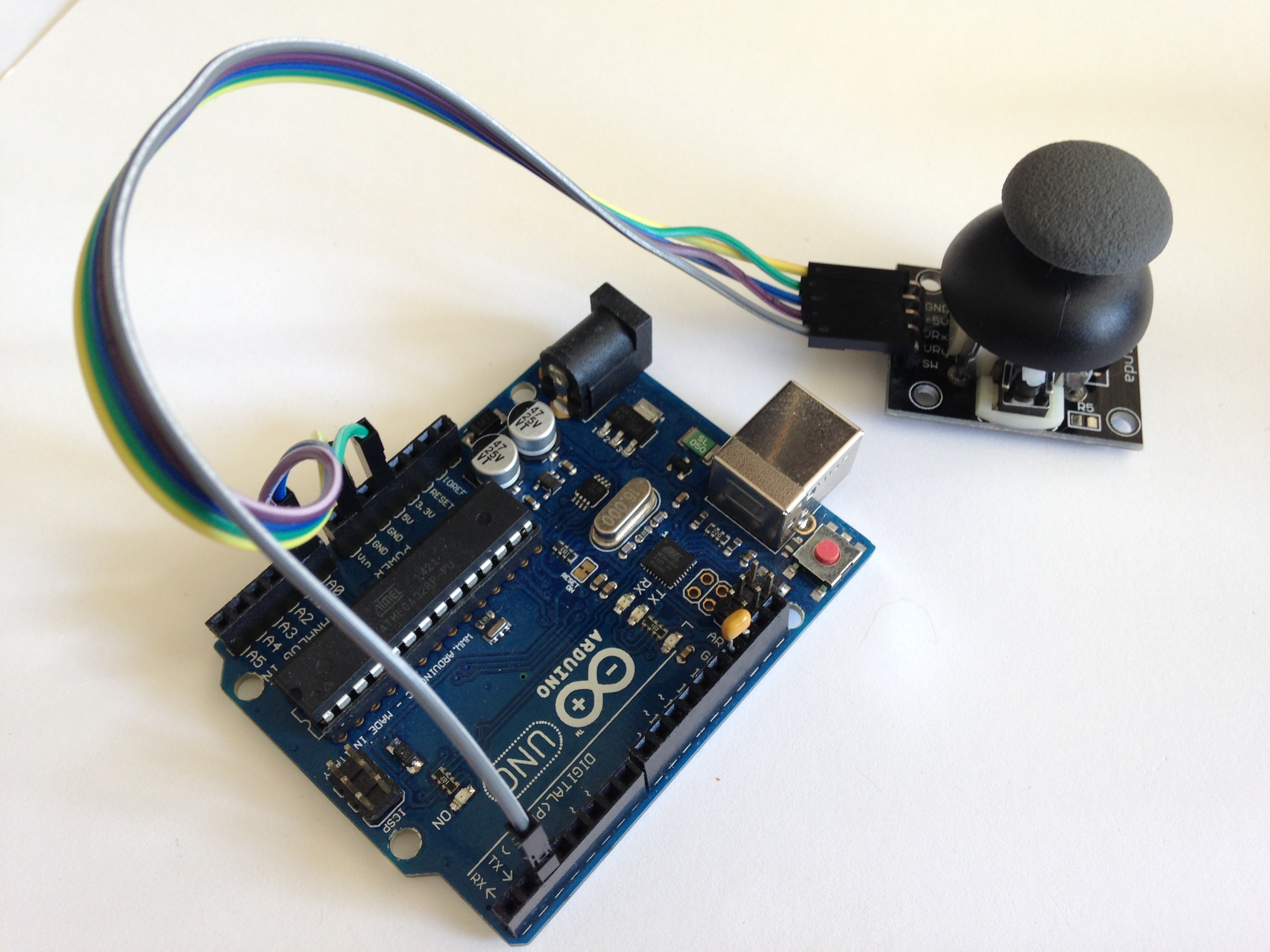
Connect an analog joystick to an Arduino. Read two analog values (x- and y-position) and a switch using a method witch does not hog the processor during the whole ADConversion. The capacitor reduces digital noise on the analog readings. Code static const byte ADC_CHANNEL_JOYSTICK_X = 0; static const byte ADC_CHANNEL_JOYSTICK_Y = 1; static const byte ADC_CHANNEL_MAX = 2; […]

Read More
Arduino tutorials

Blink LED

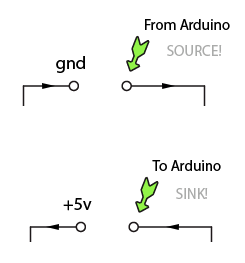
Limit the current flow through the LED with a small resistor R1, ca 200~1000Ω. Otherwise the LED will burn. The LED can be connected in a few ways. • Either the Arduino pin (pin 13 in this case) SOURCES 5v to the LED: the LED’s + pin is connected to the Arduino pin. The LED’s – pin is connected to GND. • Or the Arduino […]

Read More
Arduino tutorials

Read a pot, print to Serial Monitor

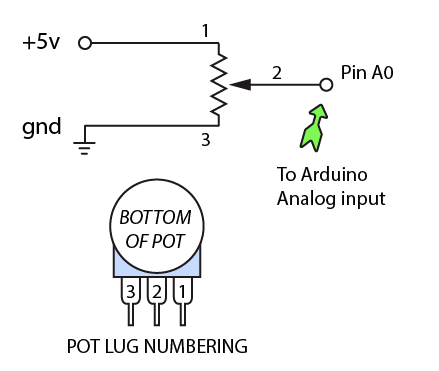
The USB connection is used for serial communication between Arduino and computer. The potentiometer pin 2 is connected to Arduino pin A0. analogRead is then used to measure the voltage at the pin. (The potentiometer rating doesn’t matter, but avoid lower resistances than 5k, so you don’t get an uneconomically high current flow.) You will get a value between 0 and 1023 (where 0 equals ground […]

Read More

Sign In

Register

Reset Password

Please enter your username or email address, you will receive a link to create a new password via email.